Diverticular Disease Tracker

Keeping your food, symptom and stool diary

Keeping a diary isn’t always easy, but…it can come in very handy, especially if you are still learning to manage a health condition. If you are someone that already keeps a daily diary or journal, it may be easy to add this information in to your entries. However, if you’re not someone used to keeping a diary, then you can find other ways to do it, for example, you can use the downloadable attachment here, and complete that each day before filing it away, or you can create your own version that applies more specifically for you. Not only will this help you identify trigger foods or patterns in your symptoms but it could also be a great tool to help your doctors monitor and manage your health.

NOTES:

Be honest! Write what you really ate and drank….snacks, junk and alcohol included…you need to see the whole picture, exactly as it is.

Take it to doctor’s appointments with you even if you don’t need to use it. You never know when the info could come in handy.

If you have a bullet journal, you can get really creative with this. I’ve given you guys a free downloadable and printable version of what I use. Now, unfortunately you do need to print it to get the best use out of it. I would recommend filing them each day in a binder to keep a continuous diary. How much additional information you record is totally up to you. However women may benefit also by tracking their menstrual cycle, too.

DD Tracker Printable

I’ve put together a little Diverticular Disease/Diverticulosis Tracker. You can use this to monitor what you eat, how you feel and even keep tabs on your bowel movements. I hope this proves to be helpful. The file even has it’s very own instructions that show you exactly how to use it. Just click on the download button below for FREE and you can print it out right away.
Support the creator and buy her a coffee by making a donation here: paypal.me/haylaki

Food Diary: The food sections allow space for you to write about what you ate and drank for the day.

Water Intake: You can cross out or tick the glass of water to show how much you drink each day.

Bowel Movements: The stool section provides boxes for you to keep a record of your bowel movements. There is space to write a time and or comment and a number that corresponds to the Bristol stool chart.

Symptoms/other notes: here you can mention any other feelings or symptoms you experience even if you feel they aren’t relevant. For example, headache, joint pain, nausea, delicate mood, etc. or even record that you took pain medication or anything that you don’t usually take. In addition, you could note anything else there you wish.

Medication: It’s always worth making a note of any medication you had to take, whether it seems related or not. But taking medication such as painkillers or antacids is a good way to keep a record of how often your symptoms bother you enough to reach for the medicine cupboard.

Tracker Previews
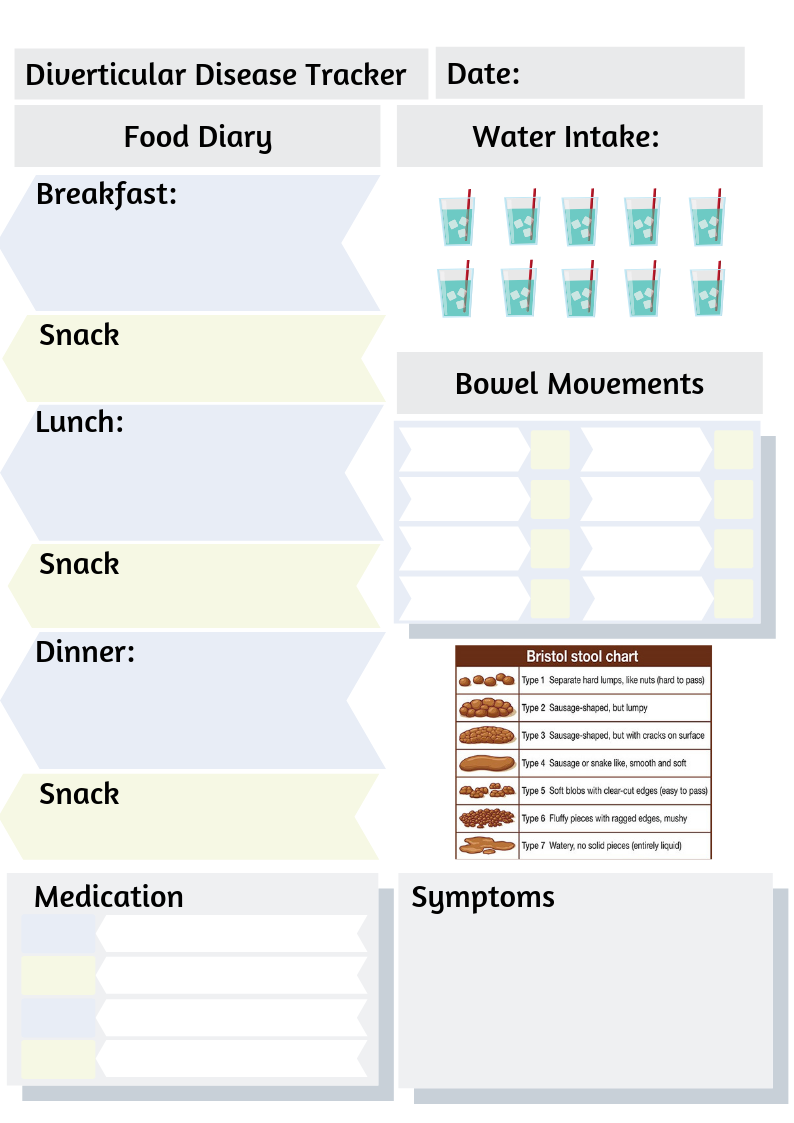
Preview of the DD Tracker
Instuctions and examples

Let me know what you think and even share with me what you record in your diary to help you…do you do anything differently?

7 Tips for good digestion

Eating is something we do to get all of the nutrients that we need to be healthy and live an active lifestyle. A lot of people suffer with poor digestion and get symptoms such as stomach ache, bloating, indigestion, acid reflux or even just feeling sluggish. So, what can we do to prevent these problems?

Try these 7 tips to help your digestive system work in tip-top condition.

1. Eat slowly

When eating, it’s a good idea to eat slowly. This way you’re more likely to chew your food and not eat more than your stomach needs to satisfy your hunger.

2. Chew your food well

Digestion begins in the mouth, here we physically break down food by using our teeth, but we also begin to chemically digest food using our saliva. An enzyme in our saliva called Amylase helps us break down carbohydrates into sugars that will give us energy before we even swallow our food. To make food easier for our stomach to digest, we should chew our food very well until it is like a paste and is easy to swallow.

3. Avoid drinking lots of liquid while eating

Drinking lots of water at the same time as eating can overfill our stomach and cause us a lot of discomfort. It can even cause our stomach to stretch over time.
It’s best to avoid drinking for around 20-30 minutes either side of your meal. Of course, you can have a couple of small sips to cleanse your palette or wet a dry mouth, but our stomach and stomach acid can do a better job to digest our food without a lot of water entering the stomach at the same time.

4 . Avoid eating after 7 pm

A lot of people suffer with indigestion or acid reflux in the evening or when in bed at night and one cause of this could be eating too late in the evening. When we sleep, our digestive system slows down and doesn’t work as efficiently as it does during the day. Because of this, it’s a good idea to avoid eating after around 7pm or for about 4 hours before you go to bed. This gives food time to be digested and exit the stomach, meaning there isn’t lots of acid when you go to bed. However, there are lots of other reasons why you might be getting acid reflux or indigestion on a regular basis and this should be discussed with your doctor.

5. Avoid laying down or napping after a meal

Just as I mentioned above, sleeping after a meal, although tempting isn’t good for digestion since it slows the process down, causing food to stay around in the stomach for longer than usual. Laying down is also not a great idea because it can mean acid is more likely to escape from the stomach and go up into the oesophagus, giving us that burning sensation in our throat.

6. Stop eating if you don’t feel hungry

We know it’s rude to waste our food, but, it’s bad for our health and our digestion to eat portions that are much too large for us. Large portions are difficult for us to break down all at one time and can also stretch our stomach and make us feel bloated and uncomfortable. Remember, it takes around 20 minutes for the hormones produced by the stomach to tell your brain that you’re full. This means that many of us overeat. Eating slowly will certainly help us to receive that signal before we indulge too much.

It’s okay to say ‘no thank you’ – in fact, your digestive system might even thank you for it!

7. Eat small portions regularly

As we’ve seen above, large meals are hard on the digestive system. It’s much better for your body to eat smaller meals more frequently throughout the day than going hungry all day and sitting down to a huge meal in the evening.
But doesn’t eating more meals each day mean more cooking? Not necessarily…you can easily cook your lunch and split it into several portions to eat later in the day.

Do you get discomfort after eating and have any of these tips helped you? Let me know in the comments below.

What is a clear liquid diet?

Sometimes when we have problems with our stomach or digestive system, we may be asked by our doctors to stick to a clear liquid diet for a couple of days.

So, what can we have while on a clear liquid diet? Well, that depends a little bit on why you’re following it. For example, if you are preparing for surgery or a colonoscopy, you may have extra restrictions in place.

Generally, though, clear liquid diets involve anything that is a clear liquid at room temperature. Examples of acceptable foods and drinks on a clear liquid diet are:

  • Water
  • chicken, beef or vegetable broth (strained to remove any pieces)
  • Black coffee/tea (no milks or creamers)
  • Herbal/green teas
  • clear soda drinks (e.g. Sprite/7up)
  • Jelly/Jello (US)
  • Clear fruit juices without pulp (e.g. clear apple juice)
  • Clear ice lollies/popsicles
  • drinks made from powdered sachets (e.g. Kool Aid, Bolero, etc.)

It’s a good idea to avoid any clear foods or drinks that have red or purple dyes. These can stain the inside of the bowel, making it look inflamed or can cause alarm if vomiting.

Are there any side effects of a clear liquid diet?

Well, this diet is not intended to be followed long term since it cannot provide all of the nutrients you need. You may notice while on a clear liquid diet that you feel hungry, maybe a little nausea at times and you may feel weak or tired. This is quite normal.

DISCLAIMER: If you are diabetic, please seek advice from your doctor before undertaking a clear liquid diet.

Have you been on a clear liquid diet before? How did it go? Let me know in the comments.