Dealing with Diarrhoea

We all get diarrhoea (US: Diarrhea) from time to time. Diarrhoea can be for a variety of reasons; an upset stomach, a stomach bug, food poisoning, IBS, diverticulitis and other bowel diseases or even nerves and stress. Diarrhoea is also quite common in those who have had their gallbladder removed.

Diarrhoea happens because not enough water is absorbed in the bowel leaving your faeces too watery. In the case of an upset stomach, stomach bug or food poisoning, having diarrhoea is beneficial since it helps our body to get rid of the bacteria causing the problem.
I personally only try to stop diarrhoea in situations where I don’t have free or easy access to a bathroom, such as, at work, while travelling, out shopping, etc.

If you do have diarrhoea, here are some handy tips to help you deal with it effectively.

Stay hydrated
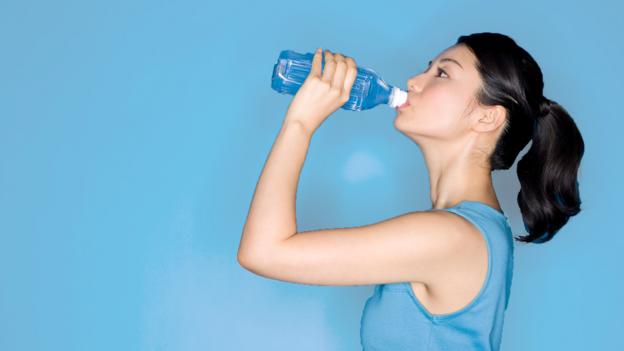
Drink lots of water. Staying hydrated is very important because our body needs water to work. If we become dehydrated, we are likely to feel even worse. For example, dehydration can cause dizziness, headaches, confusion and nausea. Drinking lots of water will replace that being lost when we have diarrhea and help our body to work efficiently.

Rehydration sachets

If you have bad diarrhoea, re-hydrating with water may not be enough since you also loose salts and electrolytes. For these occasions, you can use rehydration sachets, one well known brand is Dioralyte. This is mixed with water and available in different fruit flavours such as blackcurrant, strawberry and orange.

BRAT diet

Now, if you have diarrhoea due to a stomach bug or food poisoning, I wouldn’t recommend eating at all until the diarrhea has stopped. However, if you have diarrhoea because of IBS or gallbladder, you could try the BRAT diet. This is eating small portions of B – bananas, R – rice, A – applesauce and T – toast. The bananas are especially useful since they can replenish any potassium that the body has lost.

Anti-diarrhoea medication

Taking medication for diarrhoea is not recommended in all cases and shouldn’t be done regularly unless instructed to do so by a medical professional. For example, in the case of diverticulitis, some doctors warn their patients away from anti-diarrhoea medication because it

There are a number of medications that can help stop diarrhoea. One of the most common is loperamide hydrochloride (often sold in the UK under the brand name, Imodium). However, many supermarket and pharmacy chains sell their own version of this medicine, which is the same and often cheaper.

Complications and when to seek help

You can click here for advice on diarrhoea and vomiting or here to see guidelines for when you should consider visiting your doctor.

NOTE: If you are diabetic, please take steps to ensure your blood sugar is well-controlled. You may want to speak to your diabetes nurse or consultant about what to do in this case.

Are these helpful tips? Do you do anything differently to deal with diarrhoea? Let us know in the comments.

Preparing for a colonoscopy

So, you’re going for a colonoscopy…don’t worry. It’s not as bad as you might think! A lot of people say that the preparation is worse than the procedure, so let’s look at how we can make it as smooth a ride as possible.

Two days before the colonoscopy

Reduce the amount of fibre in your diet and adopt a low residue/low fibre diet. Cut out fruit and vegetables and eat plain foods such as chicken without a sauce, white rice, white bread, and clear soups. This makes the preparation much easier on your body. Also eat lightly, try not to eat too much, have small portions and drink lots of water. You may feel quite hungry, but, this will certainly reduce the amount of toilet trips when you take your preparation agent.

Preparation dayOn the day before the colonoscopy

I prefer to book a morning appointment for my colonoscopy and not eat anything on the day before my colonoscopy. However, if you have booked a later afternoon or evening appointment, your doctor should give you a schedule for when to take your preparation agent and stop eating and stick to a clear liquid diet.

NOTE: You MUST tell the colonoscopy team or your doctor before doing the preparation if you are diabetic.

When I had my colonoscopy, my doctor gave me Citrafleet to use. It was in two sachets each of which were to be mixed in one glass of water. The Citrafleet tasted like lemon and was definitely fine to drink without too much trouble.

The preparation agent my doctor prescribed for me.

Some doctors give their patients different preparation agents, these can come in large bottles, sachets and some are difficult to drink. Tips for making these drinks more palatable include: keeping it cool, using a straw, adding a flavour or chasing it with a clear drink you enjoy.

REMEMBER: Avoid eating or drinking anything that is red, pink or purple in colour. This can stain the lining of the bowel and can affect the results of the colonoscopy.

Prep day kit!

  • prep agent
  • drinks – I had green tea, water, iced tea, Sprite
  • Vaseline
  • baby wipes
  • A show or set of movies that you know well and love to watch.
  • Someone to hang out with
  • hobby (crochet, reading, etc)
  • paint your nails, do a face mask, do your hair, etc.

The urge to go can be sudden and come from nowhere…be ready to spring up and run to the bathroom! Be careful of cables, yarn, being in a position or chair you find it difficult to get out of. Make sure your route to the bathroom remains clear. And that other family members or friends if possible can use a different bathroom if you’ve got your stuff set up in the most convenient one.

Ouch it burns!

Like with any time we get diarrhea, it can burn. So, to solve this, be proactive. Before you go for the first time, apply Vaseline or Sudocrem thickly. This will act as somewhat of a barrier and will protect your skin. Then after going to the bathroom, avoid wiping multiple times with toilet paper. If you suspect it is messy, consider using a bidet or using water to clean your bottom. Alternatively, I would recommend using baby wipes for sensitive skin. These can help you clean up without too much repeated wiping and are gentle on the skin. (the more you wipe over the same area, the more likely it is to become sore). When you’re clean, apply a new thick layer of Vaseline or Sudocrem ready to protect you the next time. This helped me so much!

NOTE: We love the environment so please don’t flush your baby wipes away. Of course it would be better not to use them at all, but it’s better to dispose of them in a bin rather than flushing them down the toilet where they can block drains or enter our waterways.

How do I know whether I’m empty and ready for the procedure?

In theory, by the end of the preparation, your bowel movements should be totally liquid, pretty much see-through and possibly yellow in colour.
If you are still passing loose stool with pieces in it or thick and not at all see-through, you should contact your doctor or a member of staff at the place where the colonoscopy is taking place.
Some places will do an enema if the bowel requires a little cleaning, but others would rather reschedule the colonoscopy and prescribe a different preparation agent.

Good luck for the procedure!

If you have any more questions about preparing for a colonoscopy, please ask them in the comments below and I’ll try to answer them or even add additional information to the blog post. How did your colonoscopy prep go and do you have any helpful tips?

Coping with constipation

Getting constipated is something that happens to everyone from time to time and there are many different reasons for why we get constipated. These could include, stress, holding off going to the toilet, a diet lacking fibre, a bowel complaint such as irritable bowel syndrome, poor gut motility, surgery, certain medications including pain killers such as codeine, etc, dehydration or even a sedentary lifestyle.

Whatever reason you are dealing with constipation, here are some helpful ways to deal with it.

Drink plenty of water

The job of the large intestine/bowel is to absorb water from our waste back into our body so that we don’t become dehydrated. However, if we don’t drink enough water, this can make our faeces (US: feces) too dried out and hard, meaning that it doesn’t move as easily in the bowel and is hard to eliminate.
Drinking lots of water will keep you hydrated and mean that not too much water is absorbed from the faeces in the large intestine, keeping your bowel movements smooth and soft.

Exercise

Staying active is very important. The body needs to get up and move in order for the muscles to be exercised well and to work properly. This includes your intestines. Spending too much time being inactive can make it more difficult for the bowel to work effectively.
Gentle exercise each day can really help to keep you regular. For example, a small walk to the shop, going up and down the stairs, or even doing some gardening or housework are all good ways of keeping your body moving.

Prune juice, raisins and figs

When a lot of people are constipated, the first things people recommend are prune juice, raisins and figs. These can all help shift stubborn waste and help us to go to the bathroom. It’s always worth keeping these handy snacks and drinks in your home if constipation is something you suffer from frequently.
NOTE: Those with diabetes should be aware that these snacks can be high in sugar and should only consume them if it is recommended to do so.

Glycerine suppositories

Sometimes people with constipation strain and push when trying to go to the bathroom. This isn’t good because straining is linked with the formation of haemorrhoids and hernias. If you want a drug-free method that works quickly to help get things moving and make going to the bathroom less hard work, you can try a glycerine suppository. They are available at pharmacies and are like a small jelly bullet. Your pharmacist can tell you more about the product such as if it is safe for you and can help tell you about how to use it. You can even get ones suitable for children and infants.

Stool softeners

Milk of Magnesia, senna, Laxido, Lactulose and Movicol are all common stool softeners. These medicines, prevent the bowel from absorbing so much water from the waste and so help it to stay soft and easy to pass. However, near in mind that these medicines can take time to work and that it’s important to be patient before taking the next dose. You can discuss with your doctor or pharmacist which stool softener is the right one for you.

Increase fibre in your diet

Since constipation can be caused by a lack of dietary fibre (US: fiber), it’s important to make sure that your diet includes lots of high-fibre foods such as fresh fruit and vegetables, whole grain cereal and crackers, brown bread, pasta and rice.
Bear in mind, though, some people with bowel problems such as IBS and diverticular disease/diverticulitis may experience discomfort after high-fibre foods. For these situations, you should speak to your doctor about if a soluble fibre supplement might be more suitable for you.

Complications

If constipation is something that you are experiencing frequently, it’s important to discuss this with your doctor because sometimes, getting constipated can be an indication of a problem. For more guidance and tips of constipation in children and babies or indications of when you should visit a doctor with constipation, click here.

What tips do you have for those suffering with constipation? Let us know in the comments.

5 Ways to reduce nausea

It is quite common for people with digestive problems to suffer with nausea. This can be because of food choices, poor eating habits, stress, gastritis, medication or could even be unexplained. If this isn’t something you suffer with frequently, you don’t need to worry because everyone feels nauseous from time-to-time. However, if you are feeling nauseous on a regular basis, you should mention it to your GP/PCP or gastroenterologist.

Nausea isn’t always followed by vomiting and there are things you can do to reduce nausea without relying on drugs.

  1. Drink water – Drinking a little water can help to settle your stomach, but take small slow sips and drink water from the cold tap rather than chilled water from the refrigerator.
  2. Take your mind off it – Thinking about how you feel sick can make you feel even worse. Try to take deep breaths and think about something else. For example, put on a TV show or a movie that you enjoy.
  3. Try some ginger – sipping on ginger tea, eating a ginger biscuit or chewing on a little crystallized ginger can really help to reduce nausea. You could also try sipping ginger ale – but again, slowly and small sips.
  4. Get some fresh air – Go and sit in the garden or on the balcony, or even open a window or door
  5. Sniff a perfume – put a spray of fragrance on a wrist and sniff it. Avoid food smells and stick to fragrances you enjoy. Having a little sniff of your wrist can help. If you don’t have a perfume or fragrance, an essential oil or even vapour rub can help alleviate nausea.

If none of the above work, then it’s time to consider a nausea medication. The best idea is to speak to your doctor or your local pharmacist about which product is the best for you!

Do you suffer with nausea? How do you cope with it? Let me know in the comments.

Diverticular Disease Tracker

Keeping your food, symptom and stool diary

Keeping a diary isn’t always easy, but…it can come in very handy, especially if you are still learning to manage a health condition. If you are someone that already keeps a daily diary or journal, it may be easy to add this information in to your entries. However, if you’re not someone used to keeping a diary, then you can find other ways to do it, for example, you can use the downloadable attachment here, and complete that each day before filing it away, or you can create your own version that applies more specifically for you. Not only will this help you identify trigger foods or patterns in your symptoms but it could also be a great tool to help your doctors monitor and manage your health.

NOTES:

Be honest! Write what you really ate and drank….snacks, junk and alcohol included…you need to see the whole picture, exactly as it is.

Take it to doctor’s appointments with you even if you don’t need to use it. You never know when the info could come in handy.

If you have a bullet journal, you can get really creative with this. I’ve given you guys a free downloadable and printable version of what I use. Now, unfortunately you do need to print it to get the best use out of it. I would recommend filing them each day in a binder to keep a continuous diary. How much additional information you record is totally up to you. However women may benefit also by tracking their menstrual cycle, too.

DD Tracker Printable

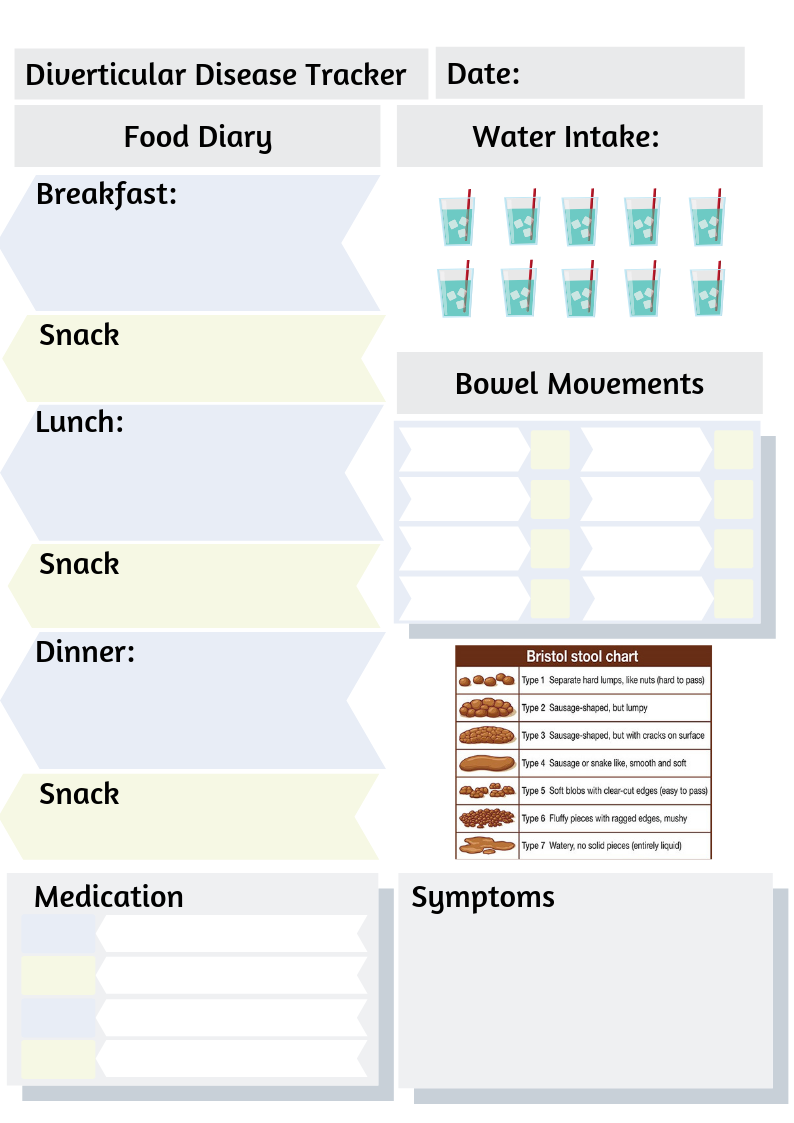
I’ve put together a little Diverticular Disease/Diverticulosis Tracker. You can use this to monitor what you eat, how you feel and even keep tabs on your bowel movements. I hope this proves to be helpful. The file even has it’s very own instructions that show you exactly how to use it. Just click on the download button below for FREE and you can print it out right away.
Support the creator and buy her a coffee by making a donation here: paypal.me/haylaki

Food Diary: The food sections allow space for you to write about what you ate and drank for the day.

Water Intake: You can cross out or tick the glass of water to show how much you drink each day.

Bowel Movements: The stool section provides boxes for you to keep a record of your bowel movements. There is space to write a time and or comment and a number that corresponds to the Bristol stool chart.

Symptoms/other notes: here you can mention any other feelings or symptoms you experience even if you feel they aren’t relevant. For example, headache, joint pain, nausea, delicate mood, etc. or even record that you took pain medication or anything that you don’t usually take. In addition, you could note anything else there you wish.

Medication: It’s always worth making a note of any medication you had to take, whether it seems related or not. But taking medication such as painkillers or antacids is a good way to keep a record of how often your symptoms bother you enough to reach for the medicine cupboard.

Tracker Previews

Preview of the DD Tracker
Instuctions and examples

Let me know what you think and even share with me what you record in your diary to help you…do you do anything differently?

7 Tips for good digestion

Eating is something we do to get all of the nutrients that we need to be healthy and live an active lifestyle. A lot of people suffer with poor digestion and get symptoms such as stomach ache, bloating, indigestion, acid reflux or even just feeling sluggish. So, what can we do to prevent these problems?

Try these 7 tips to help your digestive system work in tip-top condition.

1. Eat slowly

When eating, it’s a good idea to eat slowly. This way you’re more likely to chew your food and not eat more than your stomach needs to satisfy your hunger.

2. Chew your food well

Digestion begins in the mouth, here we physically break down food by using our teeth, but we also begin to chemically digest food using our saliva. An enzyme in our saliva called Amylase helps us break down carbohydrates into sugars that will give us energy before we even swallow our food. To make food easier for our stomach to digest, we should chew our food very well until it is like a paste and is easy to swallow.

3. Avoid drinking lots of liquid while eating

Drinking lots of water at the same time as eating can overfill our stomach and cause us a lot of discomfort. It can even cause our stomach to stretch over time.
It’s best to avoid drinking for around 20-30 minutes either side of your meal. Of course, you can have a couple of small sips to cleanse your palette or wet a dry mouth, but our stomach and stomach acid can do a better job to digest our food without a lot of water entering the stomach at the same time.

4 . Avoid eating after 7 pm

A lot of people suffer with indigestion or acid reflux in the evening or when in bed at night and one cause of this could be eating too late in the evening. When we sleep, our digestive system slows down and doesn’t work as efficiently as it does during the day. Because of this, it’s a good idea to avoid eating after around 7pm or for about 4 hours before you go to bed. This gives food time to be digested and exit the stomach, meaning there isn’t lots of acid when you go to bed. However, there are lots of other reasons why you might be getting acid reflux or indigestion on a regular basis and this should be discussed with your doctor.

5. Avoid laying down or napping after a meal

Just as I mentioned above, sleeping after a meal, although tempting isn’t good for digestion since it slows the process down, causing food to stay around in the stomach for longer than usual. Laying down is also not a great idea because it can mean acid is more likely to escape from the stomach and go up into the oesophagus, giving us that burning sensation in our throat.

6. Stop eating if you don’t feel hungry

We know it’s rude to waste our food, but, it’s bad for our health and our digestion to eat portions that are much too large for us. Large portions are difficult for us to break down all at one time and can also stretch our stomach and make us feel bloated and uncomfortable. Remember, it takes around 20 minutes for the hormones produced by the stomach to tell your brain that you’re full. This means that many of us overeat. Eating slowly will certainly help us to receive that signal before we indulge too much.

It’s okay to say ‘no thank you’ – in fact, your digestive system might even thank you for it!

7. Eat small portions regularly

As we’ve seen above, large meals are hard on the digestive system. It’s much better for your body to eat smaller meals more frequently throughout the day than going hungry all day and sitting down to a huge meal in the evening.
But doesn’t eating more meals each day mean more cooking? Not necessarily…you can easily cook your lunch and split it into several portions to eat later in the day.

Do you get discomfort after eating and have any of these tips helped you? Let me know in the comments below.

What is a clear liquid diet?

Sometimes when we have problems with our stomach or digestive system, we may be asked by our doctors to stick to a clear liquid diet for a couple of days.

So, what can we have while on a clear liquid diet? Well, that depends a little bit on why you’re following it. For example, if you are preparing for surgery or a colonoscopy, you may have extra restrictions in place.

Generally, though, clear liquid diets involve anything that is a clear liquid at room temperature. Examples of acceptable foods and drinks on a clear liquid diet are:

  • Water
  • chicken, beef or vegetable broth (strained to remove any pieces)
  • Black coffee/tea (no milks or creamers)
  • Herbal/green teas
  • clear soda drinks (e.g. Sprite/7up)
  • Jelly/Jello (US)
  • Clear fruit juices without pulp (e.g. clear apple juice)
  • Clear ice lollies/popsicles
  • drinks made from powdered sachets (e.g. Kool Aid, Bolero, etc.)

It’s a good idea to avoid any clear foods or drinks that have red or purple dyes. These can stain the inside of the bowel, making it look inflamed or can cause alarm if vomiting.

Are there any side effects of a clear liquid diet?

Well, this diet is not intended to be followed long term since it cannot provide all of the nutrients you need. You may notice while on a clear liquid diet that you feel hungry, maybe a little nausea at times and you may feel weak or tired. This is quite normal.

DISCLAIMER: If you are diabetic, please seek advice from your doctor before undertaking a clear liquid diet.

Have you been on a clear liquid diet before? How did it go? Let me know in the comments.